
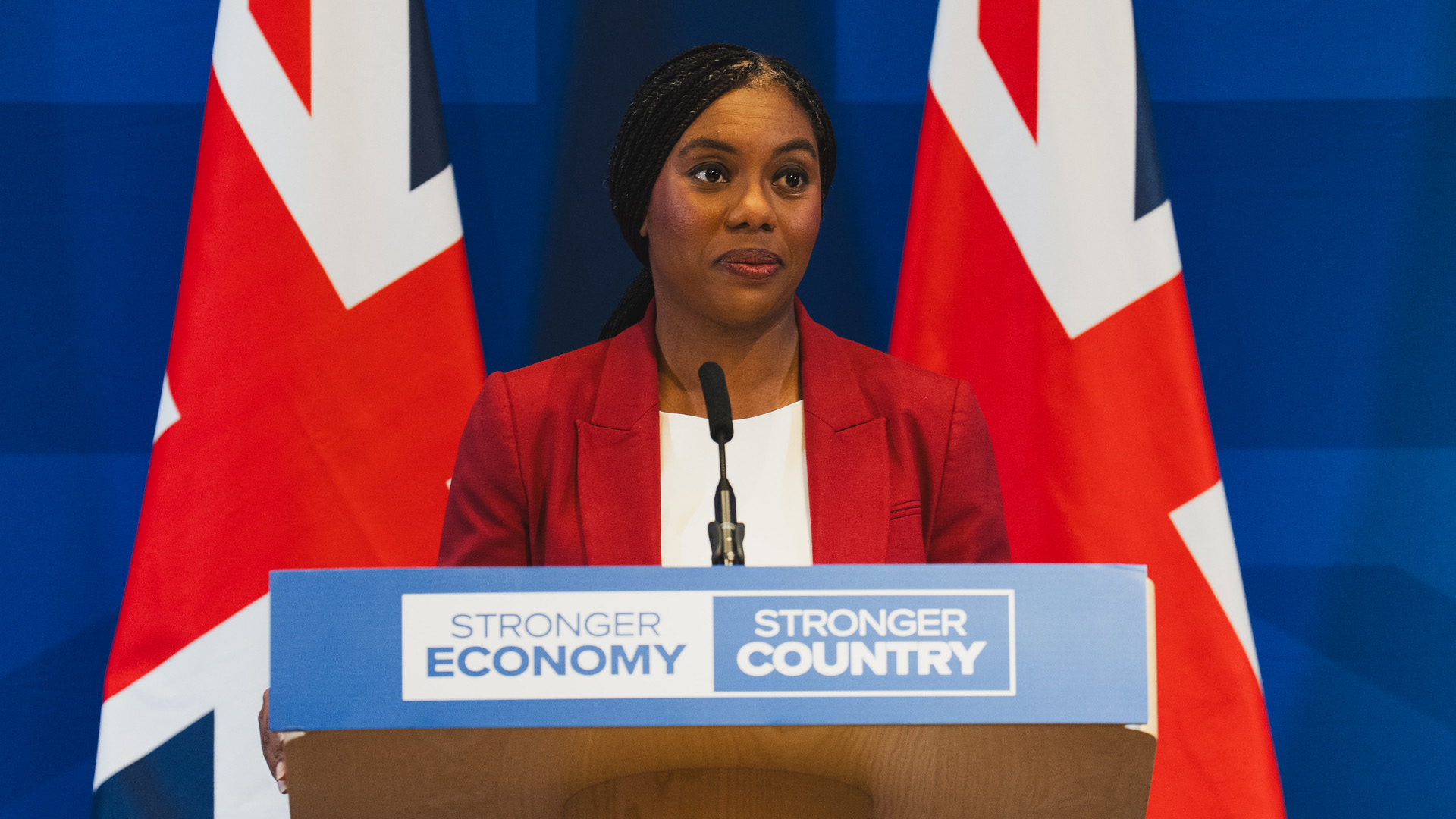
This morning Kemi Badenoch delivered a speech calling on the government to cut welfare to fund defence.
She has offered Keir Starmer, and the Labour MPs vying to replace him as Prime Minister, Conservative votes if any of them put this forward.
Watch for yourself 👇
Read Kemi's full speech below 👇:
Ladies and gentlemen, these are troubling times.
What we saw last week was extraordinary, a Defence Secretary resigning because the Government is failing to keep us safe.
We have a lethal combination of three acute and serious issues.
Firstly, ten days ago, the Prime Minister issued a chilling warning, based on a Government intelligence assessment, that there could be an attack by Russia on NATO as soon as 2030.
Secondly, five days ago, the Defence Secretary and his junior minister resigned, criticising the Prime Minister for failing to protect our national security and for not providing the funding our military needs to keep us all safe.
And thirdly, today we face a crisis of political leadership, with Keir Starmer in office but not in power, leading a paralysed government awaiting the result of a by-election and the inevitable leadership challenge.
Any one of these three issues would be cause for concern.
Taken together, they are a major threat to our national security.
We are facing this lethal combination of threats without a plan for our military.
The Defence Investment Plan is late.
Britain’s military has been in limbo for two years.
The Defence Investment Plan, or DIP, was promised in the autumn of last year.
Then it was promised in the spring.
It was promised last week.
It was promised this week.
It is still not here.
Back in April, at the London Defence Conference, I explained why Britain needed to rearm, and I said that the failure to publish this Plan was a national scandal.
The Conservatives have been pressing the Government again and again for action, with parliamentary questions, multiple votes and letters to ministers, all led by my Shadow Defence Secretary, James Cartlidge, and his deputy, Mark Francois.
This plan is supposed to be the blueprint for how the Government is going to buy the equipment, weapons and munitions we need.
Without it, we cannot rearm Britain.
Without it, our military cannot plan effectively.
Without it, we are not safe.
On Wednesday at Prime Minister’s Questions, I asked six times about the Defence Investment Plan.
The Prime Minister tried to brush it off, saying everything was fine.
The next day his Defence Secretary resigned.
Things are not fine.
They are not fine.
No British Defence Secretary has ever resigned in this way.
No Defence Secretary has ever had to write a letter telling the Prime Minister that he has been unable, and the Treasury has been unwilling, to commit the resources that the nation needs to defend the country at this time of rising threats.
No Defence Secretary has ever accused the Prime Minister of leaving Britain exposed in the face of a threat of a Russian invasion of NATO territory.
John Healey acted honourably.
He did.
He knows that an attack on any NATO country would mean a war between Russia and the West.
A war that our own intelligence assessment says could come in just four years.
Under Article 5, we would rightly be obliged to enter the conflict to defend the member state that was under attack.
If Russia invades NATO, we would be at war with Russia.
We have troops on the frontline already, in Estonia as part of NATO’s Forward Land Forces.
And yet the former Defence Secretary warned last week that Keir Starmer’s plans will reduce the readiness of our forces and increase the risk to personnel on operations.
This is exactly what Conservatives have been saying repeatedly for over a year.
And John Healey is not the only one.
The Armed Forces Minister, Al Carns, also gave his own stark warnings.
He criticised the Government’s Northern Ireland Legacy Bill, warning that it remains unfit for purpose and risks failing the very veterans it claims to protect.
He warned that the Defence Investment Plan was both inadequately funded and not transformative enough.
And yet, rather than heeding these warnings and changing course, the Prime Minister seems to be burying his head in the sand.
This morning we learned that the Prime Minister is refusing to offer any additional money to fund the Defence Investment Plan.
So he is proposing to proceed with the exact funding package that half of his defence team has just resigned over.
We read on Saturday that the Chancellor is so angry about the prospect of having to cut other departmental budgets to fund defence that she has refused to take part in the process of drawing up the cuts.
This is pathetic.
And in the middle of all this, the Energy Secretary is apparently so angered by having to make cuts that he is on resignation watch.
He is refusing to meet the Prime Minister, we hear.
The Cabinet is not up to the job.
I have been calling for the Defence Investment Plan to be published for months, but we now know the plan as currently drafted is not worth the paper it is written on.
Rushing to publish it without addressing the concerns raised by John Healey and Al Carns would be irresponsible.
There are three tests which must be met if the Plan is to protect our national security.
The first test is the funding test.
Our party’s position is that we should get to 3% by 2030, but as a minimum the funding must deliver the additional £28 billion over four years that the Chief of the Defence Staff has asked for.
Today, The Telegraph reports that the new Defence Secretary will only be offered the same £13.5 billion settlement that John Healey resigned over.
That leaves a gap of nearly £15 billion.
The second test is the readiness test.
This means the funding for the Plan must not be backloaded into the next Parliament.
As Al Carns warned, the pressure of operations and the imperative to speed up readiness to fight comes in the next two years.
There is no point providing the money after an attack on NATO might have occurred.
The third test is the capability test.
The Plan must be transformative.
It must enable us to address the threats of the next war, not the last.
The Defence Investment Plan should equip Britain with a more lethal and operationally effective Armed Forces, with a mixture of traditional equipment and modern technology, such as drones and counter-drone systems.
James Cartlidge and I have toured the country meeting the brilliant British businesses that are providing cutting-edge technology to Ukraine.
They are providing technology to Ukraine, but these same companies cannot get a contract with our own Armed Forces.
That makes no sense.
If the Prime Minister is unable to provide the leadership within his Cabinet to deliver a Defence Investment Plan that meets these three tests, then he should resign now and make way for a leader who can.
What is the solution?
It is the same solution I have put to Keir Starmer week after week since February last year, including last Wednesday.
It is the solution that even Tony Blair, the authors of the Government’s own Strategic Defence Review, Lord Robertson, former Chief of the Defence Staff Lord Stirrup, and former Labour Defence Secretaries are all pointing towards.
They are all saying the same thing.
That solution is to cut the bloated welfare state to fund defence.
The problem facing the Government is that, despite Labour’s huge parliamentary majority, there is no majority in the Labour Party for serious welfare reductions.
The Prime Minister failed to get even modest changes past his backbenchers.
Very modest changes that would still have left the benefits bill increasing.
He still could not get those past his backbenchers.
So my party is willing to work with any Labour leader, in the national interest, to cut the benefits bill to pay for defence.
I have made an offer to work together repeatedly for well over a year, since February 2025, because I could see what needed to be done.
Some things are too important for party politics.
But if the Prime Minister will not accept my offer, I will make the same offer today to Andy Burnham.
I was glad to read this weekend that Andy Burnham was thinking along the right lines.
He talked about reducing welfare to pay for defence.
But his idea that we can reduce the benefits bill purely by reducing the underlying long-term causes of demand is fanciful.
We cannot make immediate savings on welfare by spending even more money on skills or employment support.
Yes, we all want to get more people off welfare and into work, but we have to bring down the benefits bill fast because Britain needs the money to pay for defence now.
There is no time to waste.
We know from the Welfare Secretary’s text messages that the problem is not just the Labour leadership.
It is Labour MPs.
Pat McFadden revealed that those Labour MPs are always asking for more taxes so they can hand out more benefits.
So changing leader will not solve the problem of those backbenchers.
That is why I am offering 115 Conservative votes in Parliament for welfare reforms.
One hundred and sixteen if you count my own as well.
But I make the offer of working with Labour because no other party is taking defence seriously right now.
No other party.
What are the Liberal Democrats doing?
Their proposal is more borrowing when we are already borrowing dangerous amounts.
We cannot afford more debt.
We are already spending more on the interest on debt than we are spending on defence.
The Liberal Democrats are not serious.
Reform UK blame NATO for the invasion of Ukraine.
They are Putin apologists who do not even have a Defence Spokesman.
They are not serious.
And the SNP want to abandon our nuclear deterrent and ban new North Sea drilling.
That would leave us with less energy security.
They are not serious.
Only the Conservative Party is taking this seriously.
We need to get to spending 3% of GDP on defence by 2030.
My party has shown that we will take the difficult decisions needed to get there.
So we have promised to restore the two-child benefit cap in full and use that money to fund a bigger Army.
Six thousand more regular troops.
Fourteen thousand more reservists.
That money would fund the largest uplift in British troop numbers under any Prime Minister since 1945.
In contrast, on 3 February this year, Reform UK promised to spend that money on reducing beer duty.
We have promised to reallocate money from Ed Miliband’s net zero projects to create a Sovereign Defence Fund of up to £50 billion.
We want to spend the £400 million that Keir Starmer was going to spend this year on his failed Chagos deal on Royal Navy shipbuilding.
But even more difficult decisions than that are going to be required, and the answer is clear to anyone who looks seriously at this.
We must cut welfare to fund our defence.
We must.
Lord Robertson, who authored the Government’s Strategic Defence Review, said two months ago that we cannot defend Britain with an ever-expanding welfare budget.
Even Labour knows this.
They know this.
So my party will press ahead with preparing our plans to reform welfare and reduce the benefits bill.
Helen Whately, my Shadow Welfare Secretary, will be saying more about that tomorrow.
But there is no time to lose.
We cannot wait until the General Election and the next Conservative Government.
That is why I am offering to work together now in the national interest.
This is about our national security.
Today’s world is more dangerous and more threatening than we have known in our lifetimes.
Make no mistake.
Authoritarian states are working day in, day out to destabilise and divide Britain and our allies.
Russia’s invasion of Ukraine has brought war back to Europe and left Ukraine fighting not just for her own survival, but for the principles of freedom and self-determination on which we all rely.
In the Middle East, the Strait of Hormuz has been closed to international shipping for months.
And while a peace agreement is, of course, welcome, we are faced with a United States that is playing by different rules from those we are used to.
The first duty of government is to keep the country safe.
Everything else follows from that.
The best way to prevent war is to be so prepared for it that you deter your enemies from ever attacking you.
Last year, Keir Starmer promised that defence would be the central organising principle of his government.
As his time in office draws to a close, it is clear that it has not been.
He has one last chance to be a man of his word.
But if he cannot live up to this promise, the next Prime Minister must.
Britain needs leadership.
Britain needs seriousness.
Conservatives are ready to do whatever it takes to keep our country safe in the national interest.
Britain needs a government now that understands the world as it is, not as we wish it to be.


